Playtest & determinism
Writing branching content without playing it is guesswork. Parlance puts a full play session inside the canvas — with one design decision underneath that makes the rest possible: play is deterministic.
The determinism guarantee
Every session runs on a seeded RNG (mulberry32(seed + stepIndex)). Same seed,
same starting state → same rolls, same outcomes, every time. Rewind and replay
are exact. The seed changes only when you ask (🎲 randomize, or ⟳ Reroll =
seed+1).
That single guarantee is what buys:
- Rewind — every past transcript step has ↩ rewind here; the timeline truncates and replays identically.
- Reroll — flip a passed check to a failed one (or back) by nudging the seed, without touching your stats.
- Route fixtures — scripted playthroughs with assertions that CI replays byte-for-byte. Deterministic play is why a "story test" can exist at all.
A session, end to end
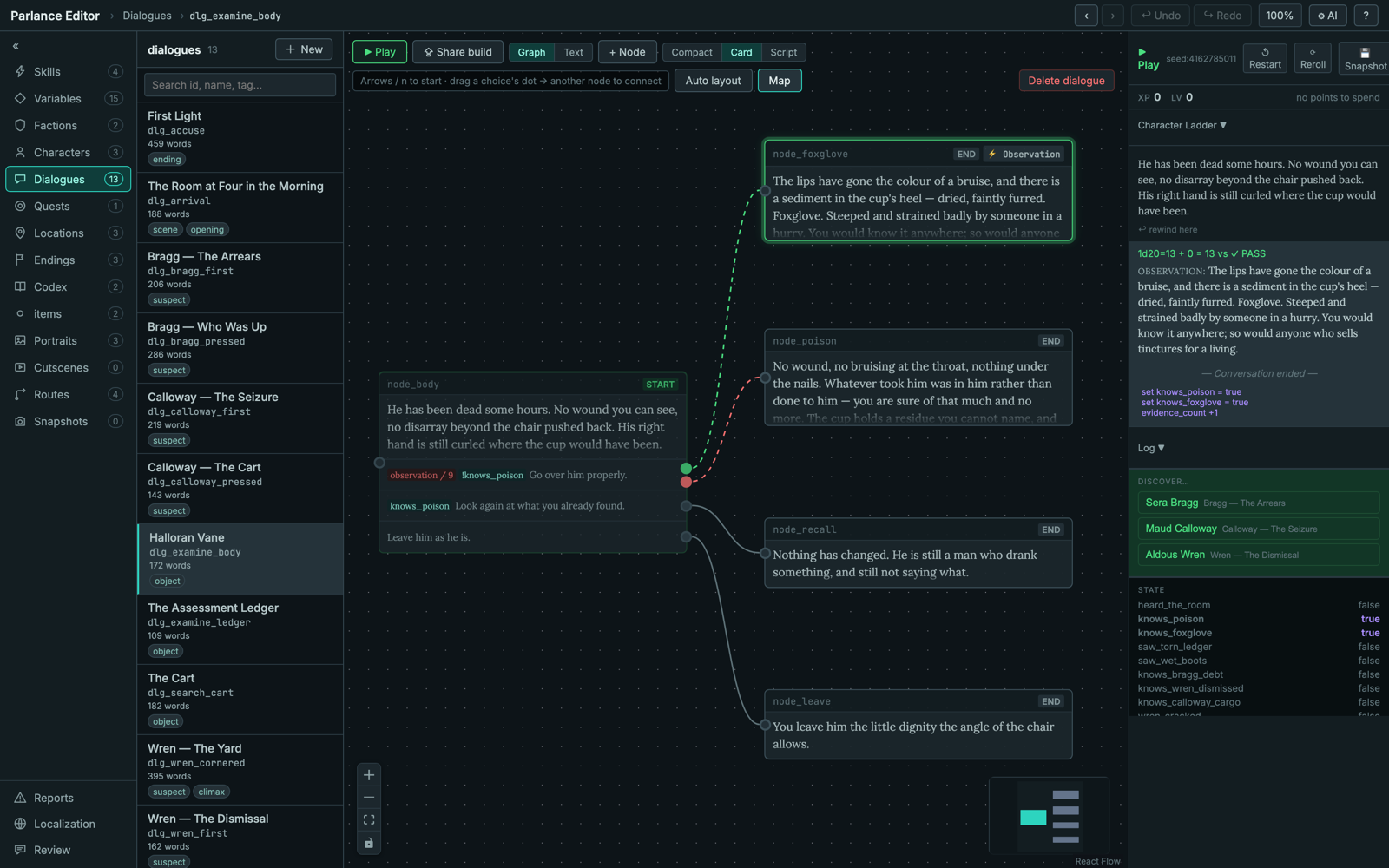
A live session on the demo's body-examination scene: the roll, the effects it fired, the discovery pool, and the state it changed — all in one panel.
Open any dialogue, hit ▶ Play (manual):
- Starting state editor — every skill, flag, and text variable this scene actually references is offered as an input, pre-filled from declared defaults. Start at any node to fast-forward ten choices deep without clicking there.
- The transcript shows each beat: resolved speaker and line (with
{placeholders}substituted from state at that step), the visible choices, check results asd20 + skill vs difficulty, and every applied effect — purple if it changed state, grey if it was a no-op. - force ✓ / force ✗ on any active check take the success/failure branch regardless of dice — test both sides of a branch in seconds.
- State inspector — live values of everything the scene touches, highlighting what just changed.
- Cross-scene continuation — when a conversation ends, continue straight into an explicitly routed next scene, or pick from the discovery pool (the dialogues whose conditions now pass — the same set the game itself would offer), carrying accumulated state forward.
Edit while playing
A running session survives edits to the scene it's playing. Reword a line, add a node, rewire an edge — state (flags, XP, reputation) carries over and the session re-reads the content, recomputing visible choices where you stand. The loop becomes: hear the beat, fix the beat, hear it again — seconds, not restarts.
Read-only, and honestly so
Playtest never writes to dialogue or layout files — content is byte-identical
before and after any session. advance_quest effects appear in the transcript
but are no-ops in playtest (quest stage tracking belongs to the host engine —
see the engine contract).
Share builds: playtesting beyond the editor
⇪ Share build exports the current scene as a single self-contained HTML file — the same core engine, checks rolling, gates evaluating, scenes routing, in any browser with no install. It's the handoff format for "just play this and tell me if the confession lands": send one file to a writer, a tester, a designer on another team. The demo is exactly such a build.
Next: the hands-on tutorial · turn transcripts into CI tests