Dialogue offers
The problem
The player walks up to a character. Which conversation plays?
Not "which conversations exist" — which one plays right now, given
everything that has happened: what the player knows, what they carry, what
they've done. Most tools answer with scripting: if chains in the engine, or
availability flags scattered across the dialogues themselves. Both drift, and
neither can be checked.
Parlance's answer is the offer: each dialogue self-declares when it should play, and the engine picks the best fit. There is no ordered list to maintain and no array position that silently decides the outcome.
The mechanism
A dialogue carries an optional offer object — { character?, when?, priority? }. Its presence is the opt-in: a dialogue with an offer is a
candidate for that character; one without is reached only by direct routing (a
choice's goto, a scene push, a world placement). Resolution is the entire
rule — this is the shape of the runtime contract:
resolveCharacterDialogue(state, character, project, visited?):
  candidates = every dialogue whose offer is for `character`
               and whose `when` passes (absent `when` = always)
  drop any visited, non-replayable candidate
  pick the best by: highest priority tier,
                    then most specific condition,
                    then lowest id
  (nothing left → null)
Consequences fall straight out:
- Order in the file never matters. A dialogue carries its own eligibility; where it sits in the project is irrelevant. "Most specific wins" is the engine's job, not something you hand-sort.
offer.characterdefaults to the dialogue'sspeakerId— set it only when one character presents a scene spoken by another.- An offer with no
whenis a fallback — offered whenever nothing more specific or higher-tier applies. Give a character one and they always have something to say. offer.priority(default 0) is a tier. A higher tier beats every lower-tier candidate, however specific — the escape hatch for "this must win now."- Nothing matched →
null. The character has no dialogue right now. Legal, but usually a mistake — see the checks below.
Re-entry needs no special code: talking to a character again just re-runs resolution against current state, so once flags change, a different offer wins.
A worked example
When the player talks to a character, the engine gathers every offer aimed at them, keeps the ones whose gate passes, and picks the most specific:
flowchart TD
    Start([Player talks to Wren]) --> Gather["Gather Wren's offers"]
    Gather --> C1{"Cornered:<br/>knows_wren_dismissed?"}
    Gather --> C2["First Meeting:<br/>(fallback — no gate)"]
    C1 -- "true" --> Win1["Most specific candidate wins → Cornered"]
    C1 -- "false" --> Win2["Only the fallback applies → First Meeting"]
    C2 -. always eligible .-> Win2
Each dialogue declares its own offer — Wren's two live in the dialogue files, not on the character:
// dlg_wren_cornered.json
"offer": { "when": { "type": "flag", "flag": "knows_wren_dismissed", "value": true } }

// dlg_wren_first.json
"offer": {}
Talk to Wren early and only the fallback applies — you get dlg_wren_first, the
polite apothecary. Learn that Vane dismissed him without a character
(knows_wren_dismissed, set by another scene), come back, and the gated offer
is now the most specific candidate: you can corner him. Nothing scripted a
transition, and neither dialogue references the other — the engine re-picked.
"I sell tinctures, magistrate. Nothing stronger."
"He dismissed you without a character, Mr. Wren. In spring. Shall we start again?"
Patterns
The arc, spread across its scenes. Instead of one ordered list, each scene states the situation it belongs to: the confrontation gates on evidence, the mid-arc variations gate on their flags, the greeting gates on nothing. The arc is the same, but each piece is local and can't be shadowed by a neighbour's position in a list.
Tiers for "this wins now." When a scene must take precedence regardless of
how specific the others are, give its offer a higher priority. That is the one
place ordering is explicit — a number you set on purpose, not an accident of
array position.
The feed model. The effect set_active_dialogue doesn't write a hidden
override — it sets the flag active_dialogue__{character}, and the routed scene
carries a tier-1 offer gated on that flag. Scene routing is therefore visible as
an offer, in the same place as everything else.
NPC interactables in locations resolve through exactly the same call — a "forced" conversation is just a high-priority, flag-gated offer.
The mistakes the validator catches
Offers have a handful of classic failure shapes. All are
OFFER checks — warnings on every save,
none blocking:
- No fallback — a character has offers but none is unconditional, so in
states where every
whenfails they resolve tonulland have nothing to say. Add a no-whenoffer. - Prioritized fallback — an offer carries a
prioritybut nowhen: it wins over every lower tier forever and re-fires on every re-entry. Gate it, or drop the priority. - Unbreakable tie — two offers at equal priority and specificity that aren't provably exclusive: the lower id silently decides which wins. Make one more specific, tier it, or gate them so they can't both apply.
- Forced offer out-ranked — a
set_active_dialoguetarget that an ordinary higher-priority offer would beat while the routing flag is set, so the push plays the wrong scene. Raise the forced offer's tier. - Routes nothing —
set_active_dialoguenames a dialogue that carries no offer reading itsactive_dialogue__flag, so the push lands nowhere. - Stranded speaker — a character's dialogue that carries no offer and has no world placement: unreachable content.
A dangling offer.character, or an offer for a dialogue that doesn't exist, is
a hard error, not a warning.
Seeing it live
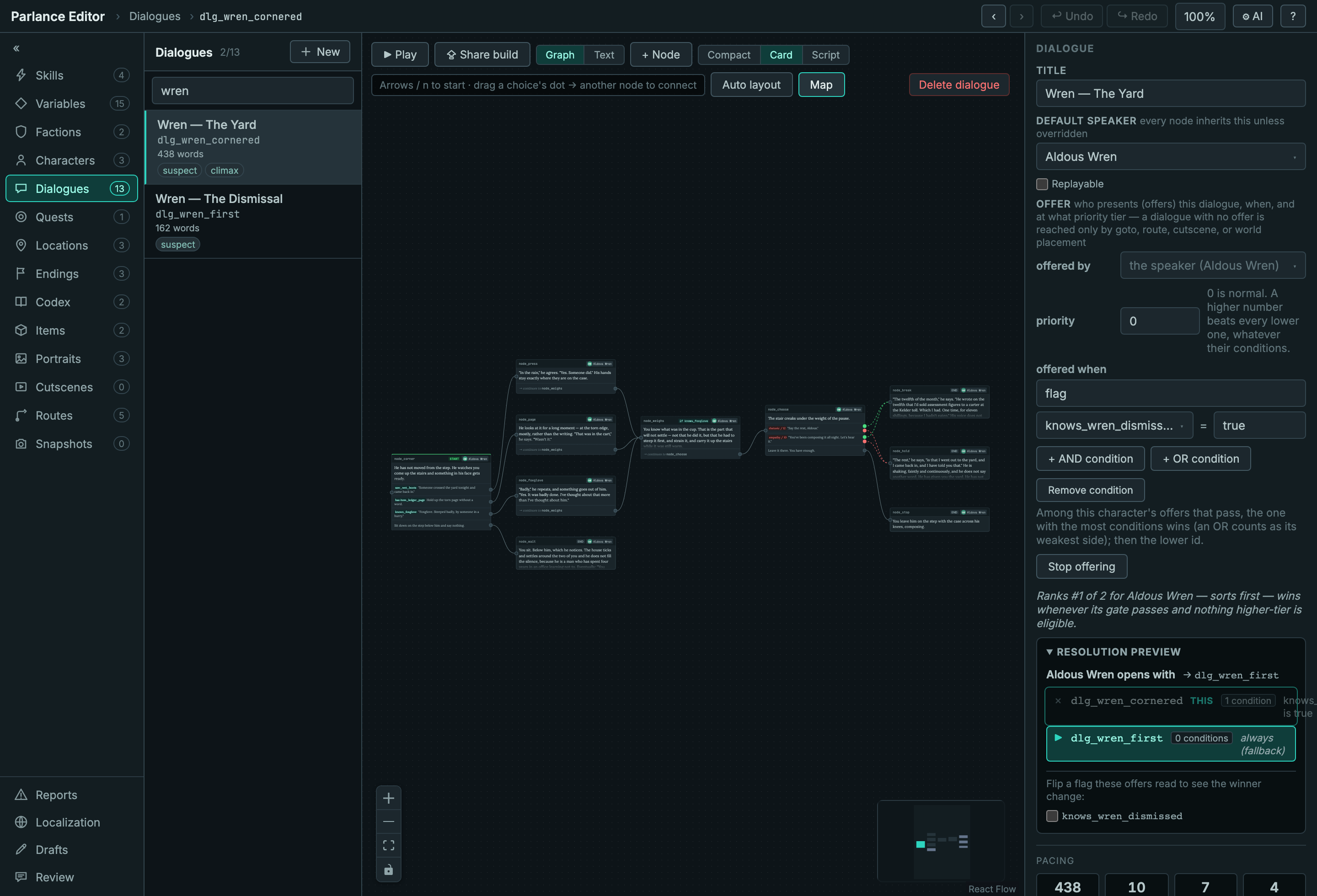
The inspector's offer editor and resolution preview — the worked example above, as you'd author and check it.
The dialogue inspector shows an offer's status — does its when pass in the
current play state? — where it ranks against the character's other offers,
and a live resolution preview that re-runs resolveCharacterDialogue and
highlights the winner. Flip a flag like knows_wren_dismissed and watch the
winner change. The preview calls the same resolution code the runtime uses, so
what you see is what ships. Try it in the
hands-on tutorial.
The guarantees
resolveCharacterDialogueis the canonical mechanism — the only dialogue selection with published conformance vectors, which every engine port must pass.- Editor preview, playtest, and engine runtime share the same resolution semantics; they cannot disagree.
- Selection is order-independent: the vectors pin the ranking (priority tier → condition specificity → lowest id), so two conformant engines resolve the same winner from the same state.
Next: build one in ten minutes, or see how offers slot into the wider loop.